 (423) 618-4477
 office@raylawns.com

Summary
Fresh mulch looks great on installation day, but one hard August storm can leave it piled against the lawn and expose bare soil around the plants. This is especially frustrating on Ooltewah, TN properties, where sloped beds and clay-heavy ground can send roof runoff across the surface faster than the material can settle. A lasting fix starts before another load is spread because the bed has to hold water in the right places and release it without carrying material downhill. The methods below explain how to rebuild the bed, redirect runoff, select the right product, and settle the mulch installation before the next storm.
Mulch Installation Holds Better On Shaped Ooltewah Clay Beds
A Lower Edge Keeps Mulch Out Of The Lawn
A bed cannot hold mulch if its surface ends flush with the grass or sidewalk. On many Ooltewah TN lots, repeated edging and soil buildup leave the bed crowned high, so stormwater crosses it and carries the top layer into the turf. The practical fix is to pull the old material back, check the runoff direction, remove excess soil at the outer boundary, and cut a clean, vertical edge about 3 to 4 inches deep. The top of the new mulch should sit slightly below the lawn or hard surface beside it, creating a small catch point rather than a launch ramp. This simple grading step gives a mulch installation a better chance of surviving the first heavy rain.
The cut edge should follow the bed’s natural curve and stay consistent rather than dipping low at random spots. Any low-lying opening is where water and mulch escape first, especially near driveways, where pavement can funnel additional runoff into the bed. Soil removed from the edge can be used farther inside to fill small depressions, but it should not be piled against shrub trunks or the foundation. After shaping, the soil beneath the mulch installation is graded so that water spreads across a broad area rather than being funneled into a narrow chute. Good landscaping here is less about decoration and more about giving water a controlled path.
Shallow Shelves Slow Water On Red Clay
Red clay can become hard and slick after several hot August days. When rain hits that sealed surface, water may skim over it before soaking in, which turns a sloped bed into a shallow slide. A contractor can correct this by loosening only the upper soil where needed, then shaping one or more broad shelves that run across the slope rather than straight down it. Each shelf should be nearly level from front to back, with a modest rise at its downhill edge. The goal is not to create obvious steps. It is to slow the runoff so the mulch rests on flatter ground.
Small terraces work well around tree groups, foundation plantings, mailbox beds, or front-entry beds that drop toward the street. They also help with Ooltewah, TN properties where the upper yard directs water toward a lower planting area. The soil should be shaped when it is workable, not saturated, because wet clay smears and compacts instead of forming a dependable base. Once the shelves are established, the mulch installation can be spread evenly without leaving a thin strip at the top and a deep pile at the bottom. If the slope is too steep for soil shaping alone, stone edging or a short retaining wall may be a better long-term solution.

Redirecting Concentrated Runoff Protects A Mulch Installation
Downspouts Need To Clear The Planting Bed
Fresh mulch often gets blamed for washing away when the real problem starts at the roof. A downspout can release a concentrated stream onto one corner of a foundation bed, and no lightweight ground cover will stay put under that repeated force. The first check should happen during rain or with a controlled hose test so the discharge point and flow direction are easy to see. If water crosses the bed, the downspout needs to be extended beyond it or connected to a drainage route that carries runoff to a suitable outlet. This correction protects the mulch installation and keeps water from digging a channel beside the house.
Extensions should not stop at the outer edge and dump water onto another sloped section. They need to reach a place where the yard can accept the flow without sending it back toward the foundation, sidewalk, driveway, or neighboring property. On compact Ooltewah lots, that may require a buried solid pipe rather than a flexible extension lying across the lawn. The outlet should remain visible or accessible enough to check for blockage, and the surrounding grade should help water move away. Decorative stone can protect the immediate outlet area, but stone alone does not correct a pipe that ends in the wrong place. A careful mulch installation plan treats roof water as part of the landscaping design, not as something added after the material is spread.
A Separate Route For Hillside Water
Some beds receive water from the yard above them even when the nearest downspout points elsewhere. This happens around homes built into rolling Chattanooga terrain, where a broad uphill area narrows beside a corner of the house or driveway. Look for flattened mulch, exposed roots, a fan of sediment, or one repeated groove through the bed after rain. Those marks show where runoff is concentrating, and that route should be corrected before another mulch installation covers the evidence. A shallow swale can guide surface water around the planting area when there is enough room and a safe lower outlet. Where the ground stays saturated, or the water has to cross a tighter space, a drainage system may be needed instead.
The right route depends on where the water begins and where it can safely end. A French drain may help collect subsurface water, but it should not be treated as the automatic answer for fast surface flow that needs grading first. In some yards, reshaping a small section above the bed is enough to spread the runoff and reduce its speed. In others, the bed edge, a hardscape corner, the nearby grade, and the drainage outlet must be adjusted together because one correction changes how the next area receives water. This is why local landscaping experience matters when a washout keeps returning in the same spot.
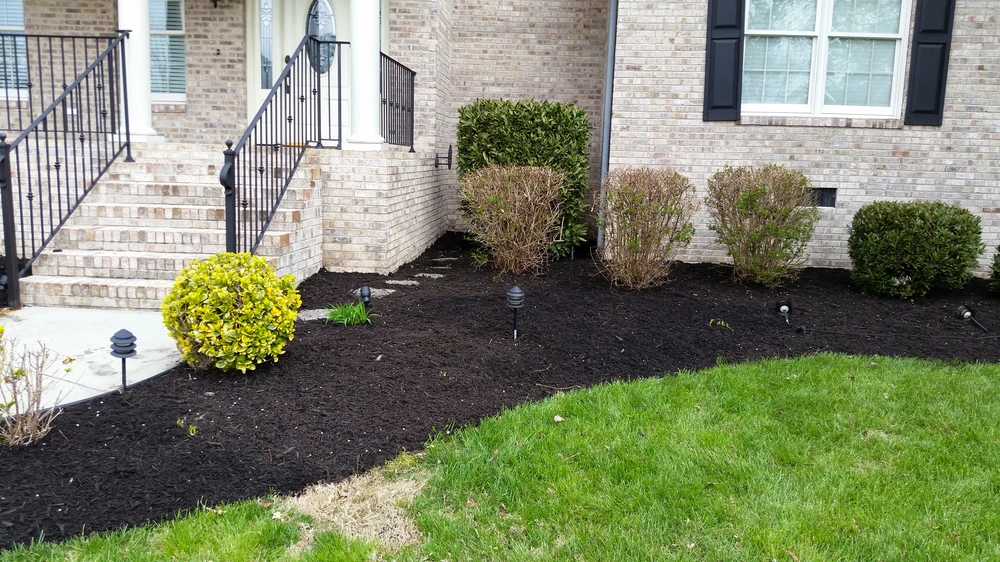
Choose Mulch Installation Materials That Resist August Washout
Fibrous Mulch Grips Exposed Slopes Better
Material choice matters once the bed and runoff have been corrected. Large pine bark nuggets may look attractive, but they can float and roll when a fast stream crosses an exposed slope. Shredded hardwood mulch or other fibrous products tend to knit together more closely when they become damp, making them a practical choice for many planting beds in Chattanooga, TN. The pieces should still be clean and properly processed, not so fine that they form a crust over the soil. Matching the product to the site gives the mulch installation more holding power without relying on plastic netting across the whole bed.
Depth is just as important as texture. On most planting beds, a settled layer of roughly two to three inches is enough to cover the soil while allowing water to reach plant roots. A much deeper mound can slide as a single heavy mass, while a paper-thin layer exposes soil and breaks apart quickly. The material should be pulled back from plant trunks and shrub crowns, as well as siding or foundation vents, rather than piled against them. On a slope, a mulch installation is spread to an even, settled depth across each shelf rather than measured only at the bottom edge. This method keeps the Ooltewah TN bed clean without creating bulky piles that shift during the next storm.
Why The Bed Needs Water Before A Storm
Mulch should not be left dry and fluffy after it is spread, especially when storms are likely later in the week. A gentle watering helps the smaller fibers settle between larger pieces and shows whether water is beginning to cut a path across the surface. The goal is to dampen the bed, not blast it with a narrow nozzle that creates the same washout it's meant to prevent. Water should be applied in short passes across the full bed with a soft shower pattern, pausing where runoff begins. If a channel forms, the soil beneath it should be reshaped before adding more material. This quick test makes it easier to correct the mulch installation while the crew is still working.
After the first strong rain, the bed should be checked instead of ignored until fall. A few loose pieces at the edge are normal, but bare soil, exposed roots, a deep groove, or a pile of mulch in the lawn means the water route still needs work. The repair should address the exact source, whether that is a low edge, an uncovered outlet, a smooth clay chute, or a bed that was spread too deeply. Homeowners should put the material back only after that source is corrected, or the same cleanup will happen again. In August, moving fast matters because another storm can widen a small channel and carry more soil. A well-built landscaping bed is checked after rain and corrected before the next downpour.

Conclusion
Mulch that washes away is usually a water and bed-shaping problem, not a reason to keep buying replacement material. When the edge is recessed, the slope is broken into workable shelves, runoff is redirected, and the right product is settled into place, the mulch installation has a much better chance of holding through Chattanooga storms. At Ray Lawns, we show up ready to fix the source and carry the work through without dragging it out or covering up the cause. As a local, family-owned company, we have multiple full-time crews with practical experience in landscaping and drainage work across Ooltewah, TN, and the Chattanooga area. If your beds keep washing out after every heavy rain, contact us and let’s get them rebuilt to work better.


